FIELD SERVICE MEASUREMENTS
Bid Calculator
Calculate the right bid total, labor cost, and profit margin for residential and commercial field service projects. Download a copy of our free calculator and use it on the go!
What is a field service bid calculator?
A field service bid calculator empowers technicians and contractors to accurately estimate the total cost of a project. This tool simplifies the process by allowing users to input essential details such as labor rates, estimated work hours, material costs, equipment expenses, travel charges, and permit fees. While manual calculations are always an option, leveraging this calculator minimizes the risk of human error, saves valuable time, and boosts overall productivity and efficiency.
How do I determine the labor rate for my project?
The labor rate is the hourly wage you pay your technicians or contractors, including benefits, taxes, and overhead costs. You may also factor in a profit margin. To stay competitive, research local industry rates and adjust accordingly to reflect your expertise and service quality.
What should I include in the material costs input?
Material costs encompass all the supplies and components required for completing the project. This includes items like wiring, outlets, switches, circuit breakers, tools, and any other necessary materials.
How do I calculate the markup percentage?
The markup percentage is calculated based on your company’s overhead costs and desired profit margin. Overhead may include administrative expenses, insurance, and utilities. A common markup range is 10% to 20%, but this can vary based on your specific business needs.
Can I use the calculator for different types of projects?
Yes, the calculator is versatile and can be used for a wide range of field service projects, whether they are residential, commercial, or industrial. You can customize the input fields to suit the unique requirements, materials, and costs specific to each type of project, ensuring accurate calculations.
What formulas are used in this bid calculator?
- Total Labor Cost = Labor Rate per Hour × Estimated Hours
- Total Direct Costs = Material Costs + Equipment Costs + Travel Costs + Permit Fees
- Indirect Costs = (Total Direct Costs + Total Labor Cost) × (Markup Percentage/100)
- Project Cost = Total Direct Costs + Total Indirect Costs + Total Labor Cost
Example:
Labor Rate per Hour = $50
Estimated Hours = 100 hours
Material Costs = $2,000
Equipment Costs = $500
Travel Costs = $200
Permit Fees = $100
Markup Percentage = 15%
Calculator total labor cost:
Total Labor Cost = $50 × 100 = $5,000
Calculate total direct costs:
Total Direct Costs = $2,000 + $500 + $200 + $100 = $2,800
Calculate total indirect costs:
Total Indirect Costs = ($2,800 + $5,000) × (15/100) = $1,170
Calculate total project cost:
Total Project Cost = $2,800 + $1,170 + $5,000 = $8,970
This example demonstrates how the calculator aggregates various costs and applies a markup to provide a comprehensive project bid.
Stop winning jobs that lose money
Get our free field service bid calculator and build bids that actually turn a profit. Account for every cost — labor, materials, equipment, travel, markup — so the jobs you win are the jobs worth winning.
Field service bid calculator: FAQs
-
What’s the difference between a bid, an estimate, and a quote?
-
A bid is a firm, competitive price submitted to win a defined scope of work, common in commercial and contract jobs. An estimate is a non-binding approximation of likely cost that can change as conditions are uncovered. A quote is a fixed, binding price the customer can accept as-is. Bids are the most formal of the three — detailed, often competing against other contractors, and legally binding once accepted.
-
What’s a good bid-to-win ratio for field service?
-
A healthy bid-to-win ratio for field service businesses is 30–50% — winning roughly one of every two to three bids you submit. Winning more than 60% often signals you’re underpricing and leaving margin on the table; winning under 20% suggests you’re overpriced, bidding the wrong jobs, or losing on presentation and follow-up rather than price. Track your ratio by job type to find where you’re most competitive.
-
How do I win more bids without lowering my price?
-
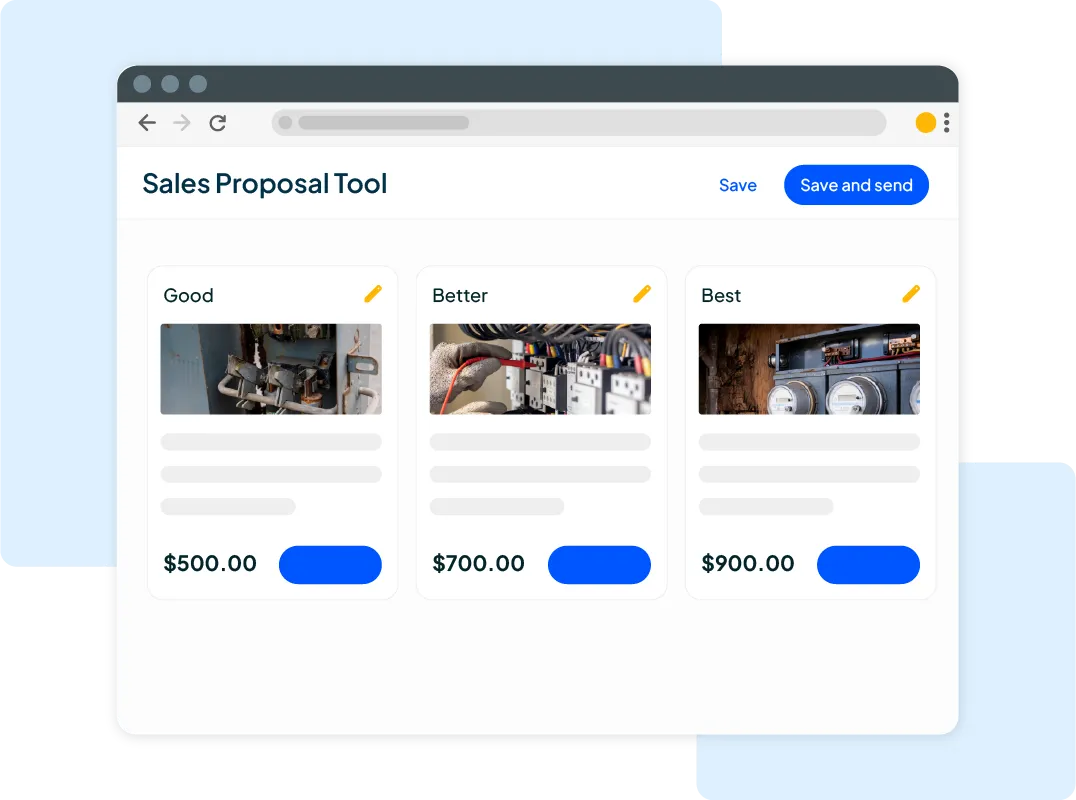
You win more bids on value, speed, and presentation — not just price. Respond fast (the first professional bid in often wins), present a clean branded proposal with clear scope and inclusions, offer good-better-best options so customers self-select, include reviews or references, and follow up within 48 hours. Most jobs are lost to slow, sloppy, or confusing bids — not to being a few dollars too high.
-
Should I bid low to win field service work?
-
Bidding low to win work is usually a losing strategy. It trains customers to expect cut-rate pricing, attracts price-shoppers who churn, and leaves no margin for callbacks, overhead, or profit. A better approach is to bid at a sustainable margin and win on responsiveness, professionalism, and options. If you must compete on price, do it by reducing scope through good-better-best tiers — not by gutting your margin on full scope.
-
What’s the difference between a fixed-price bid and a time-and-materials bid?
-
A fixed-price (lump-sum) bid commits you to a set price for a defined scope — the customer gets cost certainty, and you absorb the risk if the job runs long. A time-and-materials (T&M) bid bills actual hours plus materials with a markup — you’re protected against scope surprises, but the customer faces an open-ended total. Use fixed-price for well-defined jobs and T&M for diagnostic, emergency, or unpredictable work.
-
How long should a field service bid stay valid?
-
Most field service bids are valid for 30 days, though some shorten validity to 14–21 days when material or fuel prices are volatile. Always include an explicit expiration date and a clause noting pricing may change if costs shift before acceptance. For larger commercial projects with longer decision cycles, use a 60–90 day window and build a price-escalation clause into the contract.
-
What should a professional field service bid include?
-
A professional bid should include your company info and branding, the customer’s details, a clear scope of work with inclusions and exclusions, itemized or lump-sum pricing, payment terms, a project timeline, an expiration date, and a signature line. For commercial or government work, you may also need insurance certificates, bonding, licenses, and references. The clearer the scope, the fewer change-order disputes later.
-
How do I bid on commercial or government field service contracts?
-
Commercial and government bids are more formal than residential. Review the request for proposal (RFP) or bid documents carefully, attend any mandatory pre-bid walkthrough, perform a detailed takeoff of labor and materials, factor in bonding, insurance, prevailing wage where required, and longer payment cycles, then submit on the exact forms by the stated deadline. Missing a required document or the deadline disqualifies the bid regardless of price.
Try out some more of our field service calculators!
-


Profit Margin Calculator
Discover what to charge and find your profit margin based on your markup percentage.
-


Business Valuation Calculator
Calculate the estimated value, earnings multiple, and valuation range for residential and commercial field service businesses.
-


Markup Calculator
Discover what to charge and find your markup percentage based on your target profit margin.
-


Labor Cost Calculator
Find the total and hourly labor cost with total labor burden for any project.