Construction Financials
Estimate ROI Calculator
This construction estimate ROI calculator is designed to help residential home builders, remodelers, or general contractors calculate how much time they spend creating project estimates and the value of the estimates that they’ve won and lost over the course of a year. Download a copy of our free construction estimate roi calculator and use it on the go today!
How long should it take to create a construction estimate?
Depending on the type, size, and complexity of the project, creating an accurate cost estimate could take anywhere from less than an hour to several days or weeks.
To accurately estimate costs, you need to fully understand the scope, conditions of site, material requirements, and labor needs in order to identify what those costs are likely to be. From there, you’ll need to evaluate any potential risks or design changes that might affect your estimate. This assessment typically involves evaluating such factors as site conditions, as well as researching various codes and regulations related to permitted zoning laws in the area—all of which require additional research time before project cost estimations can be made.
Next comes evaluation of labor requirements based on industry standards based on one’s experience specific to this type of job similar ones that have previously been conducted in the same region at similar times in history (in terms of macro-economic factors). Labor rates also need to be calculated according their current market value, factoring in benefits like insurance coverage or overtime wages depending on each contractor’s policies.
From there, material quantities must also be estimated which usually requires quite an amount of historical data considering things like waste allowances for different types of materials being used during a given job (e.g., cement mix). On top of all of this, you’ll need to take into consideration numerous other variables like transportation expenses, overages/underages, etc.
For contractors that specialize in smaller and more specific projects, many of these factors may be the same for every project, thus making them easy and quick to estimate. For larger and more custom projects, the variables will be different for every project requiring more time and effort to ensure that the estimate is thorough and accurate.
What’s the average success rate of winning a construction estimate?
While there is no official research that has been conducted, but the reported averages found through various sources range between success rates of 10% to 20%. For more specialized contractors, the success rate of winning construction estimates could go as high as 40% or more.
In general, if you’re winning 1 to 2 estimates for every 10 that you generate, you’re right in line with the average success rate of other contractors.
How to win more construction estimates
If you’re winning 20% of the estimates you submit, that means that you lost out on the other 80%. While it’s unrealistic to win 100% of your bids, you may not need to increase your winning percentage by very much to generate a massive amount of additional revenue. Here are some ways that you might be able to improve your win rate:
Create more estimates
One way to increase your revenue while maintaining your existing winning percentage is by simply increasing the number of estimating opportunities. To do that, you’ll need to increase your marketing efforts, increase your target market, add another estimator to your team, or any other method you choose to increase your leads.
Be first
Being the first contractor to submit an estimate to a client is a great way to communicate that the client and their project is important as well as the speed in which you operate. Those factors can go a long way in giving you an edge over the competition. While you don’t sacrifice accuracy for speed, you’ll need to find ways to reduce the time it takes to generate your estimates — using a construction estimate template, or construction estimating software are both effective tools for saving time with estimating.
Be the trusted expert
Treat each opportunity as you would if it were your own personal project. Bring your expertise to the forefront by offering suggestions on how the client could save time, money, or future problems is a quick way to establish trust with a potential client. You’ll communicate that care more about the needs of the client ahead than just winning the job.
Be professional
The way you present yourself, your company, and your estimate matters — a lot. All of these things are factored into how the client perceives the result of your work to be. If your presentation is sloppy, the client might assume the same is true of your work.
Dress professionally, communicate clearly, be punctual, and deliver a branded proposal. In fact, Housecall Pro makes this incredibly easy by automatically turning your estimates into a professionally branded proposal that can be shared and approved online by clients. You can even try it free for 14 days.
What inputs does the construction estimate ROI calculator use?
The calculator uses four inputs to calculate your estimating performance:
- Estimates Per Month — The total number of project estimates you generate each month.
- Hours Spent per Estimate — The average number of hours it takes to complete a single estimate.
- Percentage of Estimates Won — The percentage of estimates that convert into won projects.
- Average Value of Project Estimates — The average dollar value of the projects you are estimating.
How does the construction estimate ROI calculator work? (with example)
The calculator uses four inputs to produce six results instantly. Here’s every formula with the calculation shown side by side:
Inputs:
- Estimates Per Month: 10
- Hours Spent per Estimate: 0.5 Hours
- Percentage of Estimates Won: 20%
- Average Value of Project Estimates: $20,000
Calculations:
Estimates Per Week = Estimates Per Month ÷ 4.33
Estimates Per Week = 10 ÷ 4.33 = 2.3
Time Spent Estimating Per Week = Estimates Per Week × Hours Spent per Estimate
Time Spent Estimating Per Week = 2.3 × 0.5 = 1.2 Hours
Estimates Per Year = Estimates Per Month × 12
Estimates Per Year = 10 × 12 = 120
Time Spent Estimating Per Year = Estimates Per Year × Hours Spent per Estimate
Time Spent Estimating Per Year = 120 × 0.5 = 60 Hours
Value of Estimates Won / Year = Estimates Per Year × (Percentage of Estimates Won ÷ 100) × Average Value of Project Estimates
Value of Estimates Won / Year = 120 × 20% × $20,000 = $480,000
Value of Estimates Lost / Year = Estimates Per Year × (1 − Percentage of Estimates Won ÷ 100) × Average Value of Project Estimates
Value of Estimates Lost / Year = 120 × 80% × $20,000 = $1,920,000
At a 20% win rate on 120 estimates per year with an average project value of $20,000, you are winning $480,000 in annual revenue — but losing $1,920,000 in estimates that didn’t close. That’s 4x more value being lost than won every single year.
What is a good ROI for construction estimating?
A good estimating ROI for a construction business is generally considered to be anything above 500% — meaning every $1 spent on generating estimates returns at least $5 in won project revenue. High-performing contractors with strong lead qualification, efficient estimating processes, and competitive win rates regularly achieve ROI of 1,000% to 2,000% or more. Here’s a simple benchmark breakdown:
- Below 300% — Your estimating costs are too high relative to revenue won. Look at win rate, lead quality, and time spent per estimate.
- 300% to 700% — Acceptable but room to improve. Focus on faster turnaround and better lead filtering.
- 700% to 1,500% — Healthy range for most residential contractors with a solid pipeline.
- Above 1,500% — Strong performance. You’re winning the right jobs and keeping estimating costs lean.
The most important thing to understand is that most contractors never calculate this number at all — which means they have no idea whether their bidding process is profitable or just expensive. This calculator gives you that number in minutes.
How much time should a contractor spend on estimates?
The right amount of time depends entirely on project type, size, and complexity — but here are practical benchmarks most experienced contractors work within:
- Small residential repairs and service calls — 30 minutes to 2 hours
- Mid-size residential remodel — 4 to 16 hours
- Custom home build — 20 to 80 hours depending on design complexity
- Large commercial project — Several days to several weeks
Beyond these benchmarks, a more useful question is: how much time should you be spending relative to the project value? A general rule of thumb is that estimating time should not exceed 1% to 2% of the total project value in equivalent labor cost. If it’s consistently taking more than that, your process is inefficient and your estimating ROI is suffering. Standardized templates, unit cost databases, and estimating software are the most effective ways to bring that ratio down without sacrificing accuracy.
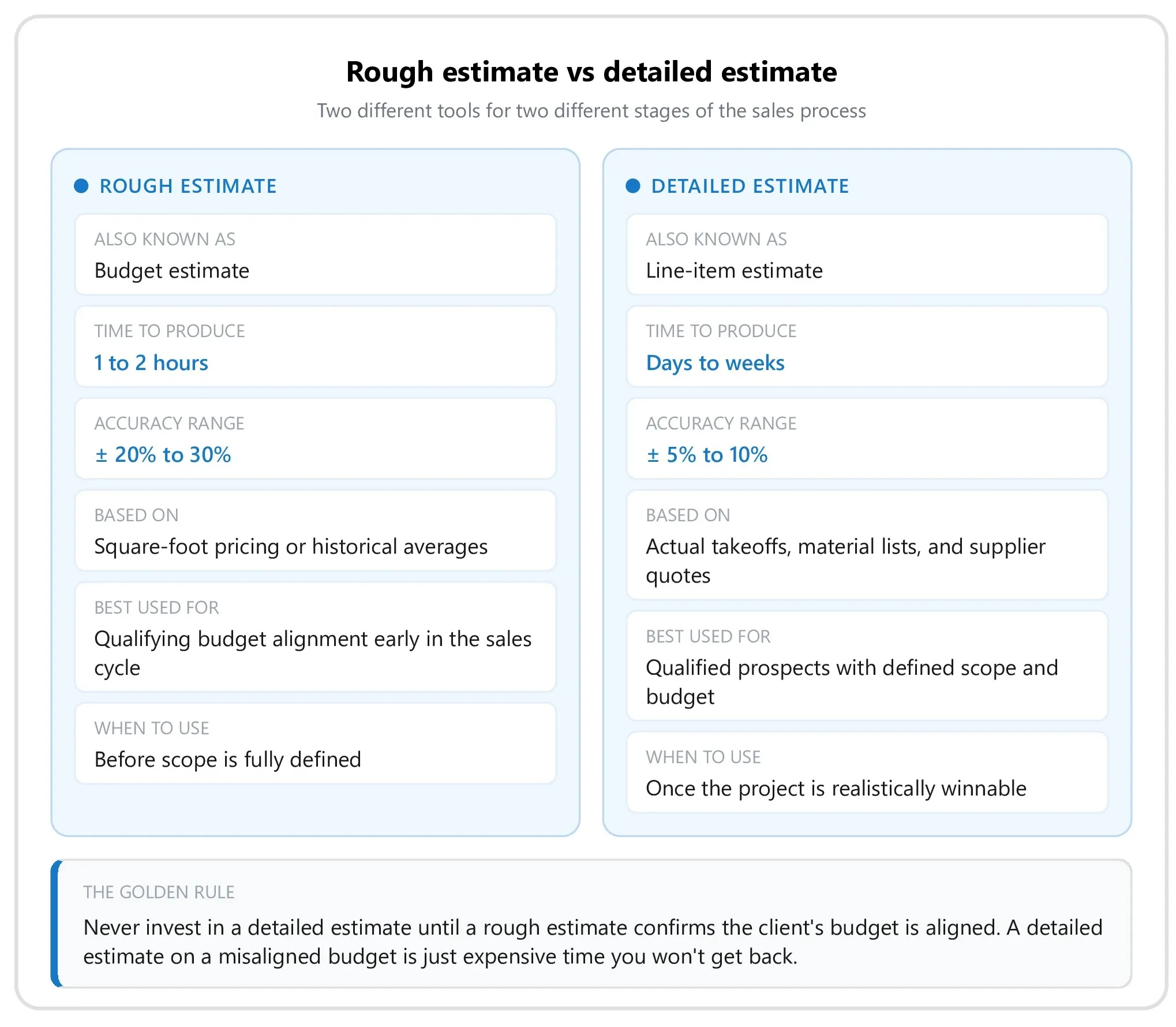
What’s the difference between a rough estimate and a detailed estimate?
Knowing which estimate to use — and when — is one of the most important decisions a contractor makes in the sales process. Use the wrong one at the wrong time and you either lose the job on a technicality or waste hours building a detailed breakdown for a client whose budget was never realistic. Here’s how the two compare:
Get the Free Construction Estimate ROI Calculator for Your Next Job
Skip the manual math on every estimate. Download the free calculator to use in planning, in performance reviews, or share with your team — get instant ROI projections, time-cost breakdowns, and won/lost value totals built for contractors who’d rather be running jobs than crunching numbers.
Construction estimate ROI calculator: frequently asked questions
-
What's the average cost of producing a construction estimate?
-
Producing a construction estimate typically costs $200–$2,000 in labor and overhead, depending on project size and complexity. Small residential remodels run $200–$500 per estimate; custom homes and complex commercial projects routinely exceed $1,500–$2,000. The full cost includes estimator hours, site visit time, drive time, software cost allocation, and the proportional share of overhead. Most contractors only count “active estimating hours” and miss the surrounding costs — which is why estimate ROI is consistently underestimated and bidding feels deceptively cheap.
-
Should I charge clients for construction estimates?
-
Free estimates remain the industry standard for residential work, but charging $150–$500 for detailed design-build estimates is increasingly common, especially for custom homes and large remodels. Charging filters out tire-kickers, raises perceived value, and recovers labor cost on bids that don’t close. The trade-off: charging eliminates many casual leads, which can hurt volume in competitive markets. A common middle ground is free initial estimates plus a paid detailed estimate that’s credited back if the client signs the contract.
-
How can I track which leads are worth estimating?
-
To prioritize leads worth estimating, score each one on budget alignment, project fit, decision-maker access, and timeline urgency. Reject leads where the budget is more than 30% below your typical project, where the prospect isn’t the decision-maker, or where the project is outside your specialty. Tracking lead source quality is equally important — most contractors find 60–70% of revenue comes from 1–2 lead sources, while other sources (random web inquiries, lead-gen marketplaces) consume estimating time without producing wins. Eliminating bottom-quartile lead sources often improves estimate ROI more than improving win rate does.
-
How do I improve estimating speed without losing accuracy?
-
To speed up estimating without sacrificing accuracy, build reusable templates for your most common project types, maintain an updated unit cost database, use assemblies (grouped line items) for repeating work, and standardize your scope-of-work language. Most experienced estimators reduce estimate creation time by 50–70% within 6 months of building proper templates. Software with assemblies, cost catalogs, and proposal generation typically cuts estimate time further — but only after you’ve invested in the underlying templates. Software alone doesn’t solve a slow estimating process; it just speeds up whatever you already have.
-
How does estimate accuracy affect project profitability?
-
Estimate accuracy is one of the strongest predictors of project profitability — contractors with consistently accurate estimates (within 5%) typically run 5–10 percentage points higher net margins than those with inaccurate estimates. Underestimating leads to projects sold at a loss; overestimating costs you bids you should have won. The biggest accuracy killers are missed scope items, outdated unit costs, unrealistic productivity assumptions, and forgotten general conditions (dumpster, port-a-potty, supervision time). Tracking estimated vs. actual costs on every completed project — and feeding that data back into your templates — is the single most effective way to improve accuracy over time.
Try out some more of our construction calculators!
-


Profit Margin Calculator
Discover what to charge and find your profit margin based on your markup percentage.
-


Concrete Calculator
Calculate the amount of concrete needed in cubic feet, yards, and bags for a concrete slab.
-


Markup Calculator
Discover what to charge and find your markup percentage based on your target profit margin.
-


Labor Cost Calculator
Find the total and hourly labor cost with total labor burden for any project.