Want to see your potential revenue?
See what businesses like yours earn with Housecall Pro in 1 - 2 minutes.
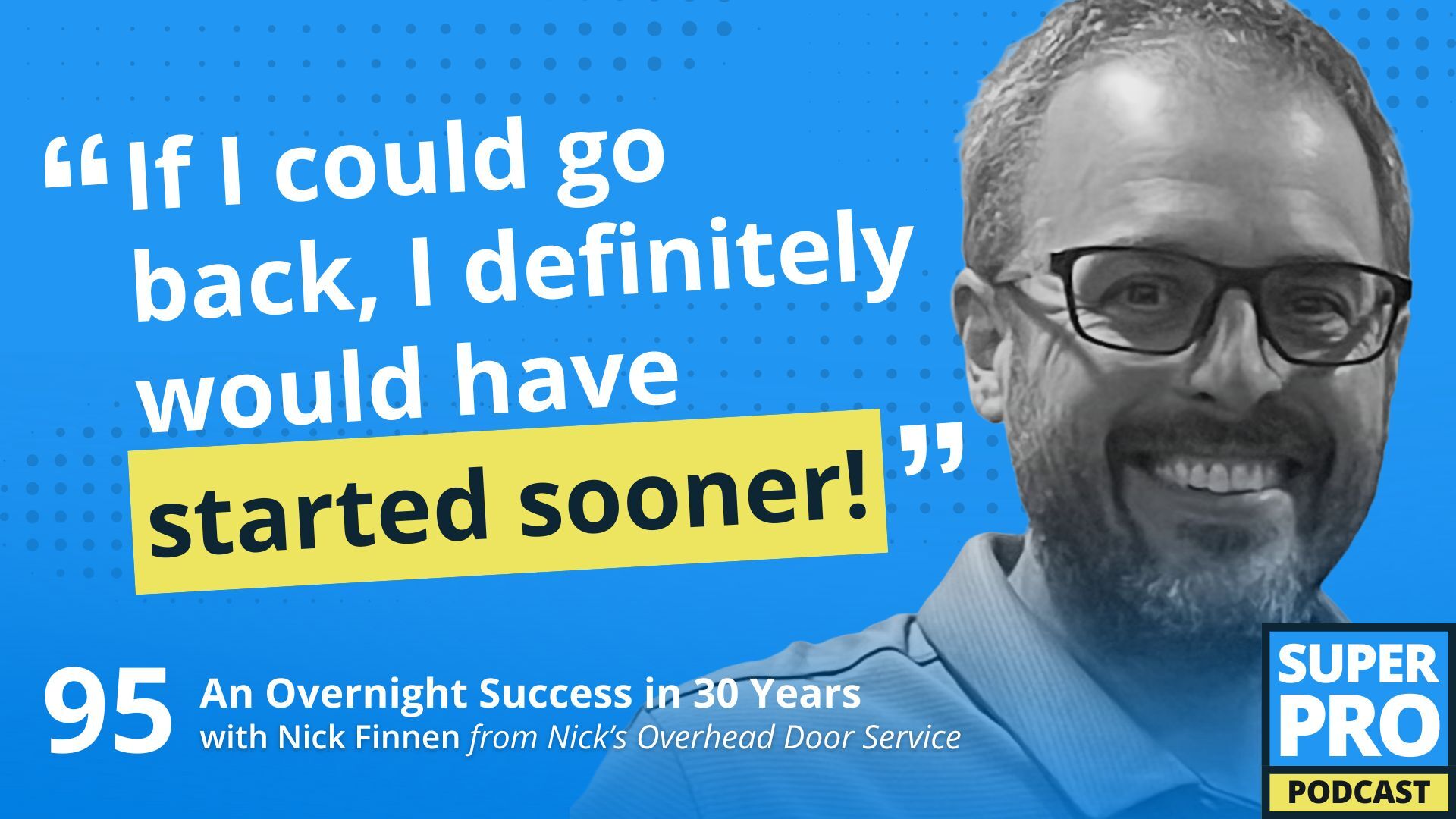
Nick Finnen didn’t stumble into the garage door business. He grew up in it.
From working weekends with his father installing garage door openers to joining the Ironworkers Union and helping build massive aircraft hangar doors large enough to house a 747, Nick spent decades mastering the trade before starting his own company.
When he finally made the leap into ownership, growth came quickly. Nick’s Overhead Door Service grew from $800,000 in annual revenue to $1.3 million last year. He’s now on track to hit $1.6 million with five employees and three trucks.
In this episode of the Super Pro Podcast, Nick breaks down what drove that growth: doubling down on local community sponsorships, tapping into referral-heavy networks like car culture, building disciplined operational systems, and using technology to eliminate day-to-day chaos. His biggest takeaway? If you’re thinking about starting your own shop, start sooner.
Learn more: How to start a garage door business from scratch
Table of contents
Episode overview: What drove Nick’s garage door business growth
After three decades in the garage door trade, Nick finally opened his own business—and had to learn how to think like a business owner, not just a technician.
In this episode, he shares the specific decisions that helped him turn industry experience into predictable business growth. You’ll hear how he tracks marketing results, uses structured workflows to prevent missed follow-ups, builds a team he can trust, and keeps jobs moving without chaos.
How local sponsorship marketing drives garage door leads
Rather than relying heavily on paid ads, Nick focused on becoming visible within his local community. With five daughters involved in school activities, sponsorship became a natural extension of his marketing efforts. He invested in high school sports, drama programs, travel volleyball, and local events. One early shirt sponsorship cost just a few hundred dollars and continues to generate calls years later.
Every incoming call is met with one consistent question: “How did you find us?” That habit allows Nick’s garage door business to see exactly which sponsorships and initiatives are producing real results.
Instead of trying to dominate competitors, Nick chose to build familiarity and trust within the community. When homeowners repeatedly see your name on jerseys, banners, and local events, you’re no longer just another garage door company—you’re the one they recognize.
Learn more: 10+ marketing ideas for garage door contractors to get jobs fast
How car shows turned into steady referral work
Nick’s involvement in car culture created another growth channel. Garage doors and high-value vehicles share the same physical space: the garage. Sponsoring car shows and engaging in enthusiast communities positioned his company directly in front of homeowners who care deeply about their garages.
When work is done well in a tight-knit group, referrals multiply. In communities built on trust, reputation compounds faster than any paid campaign. Do great work for one respected member of the group, and you don’t just win one job—you earn access to their entire network.
How better systems made growth manageable
Early in the business, Nick kept most job details in his head. That approach became unsustainable as revenue increased.
Using Housecall Pro’s Pipeline feature has become his central source of truth. He tracks job stages, deposits, material orders, and follow-ups in one place. Automated reminders on estimates help close jobs that might otherwise have been forgotten.
Technicians are also required to document installations with video before leaving a job site. That simple step has already prevented disputes and protected the business.
Timestamps
00:00 — Introduction and revenue growth overview
01:04 — From decades in the trade to starting his own garage door business
03:31 — Community sponsorship strategy and local visibility
13:50 — Leveraging car culture and referral-driven growth
18:13 — Using technology to scale reviews and operations
24:51 — Pipeline, automations, and building operational clarity
31:33 — Advice for aspiring garage door business owners
Watch the episode
Episode transcript
Guest: Nick Finnen
Host: Roland Ligtenberg, co-founder, Housecall Pro
Introduction and revenue growth overview
Roland Ligtenberg: All right, welcome to the Super Pro Podcast. I’m Roland Ligtenberg. I am the co-founder of Housecall Pro and the founder of the Super Pro program. Over the last 13 years, I’ve guided thousands—tens of thousands, probably—of home service pros to adopt technology, embrace innovation, and accelerate their growth. I love learning about the journey and sharing success stories, tips, tricks, and golden nuggets with all of you.
Today I’m really excited. We’ve got Nick Finnen, the owner and founder of Nick’s Overhead Door Service. They’re a garage door company based out of Johnsburg, Illinois, right on the Wisconsin–Illinois border. They did $1,300,000 last year and are on track to hit $1,600,000 this year. Before that, they were at $800,000. They’ve seen tremendous growth—five employees, three trucks.
Nick, thank you for coming on the show.
Nick Finnen: Absolutely. Thanks for having me.
Roland:I love hearing founding stories. What got you into business? What made you start Nick’s Overhead Door Service? What did you see was missing in the market?
From decades in the trade to starting his own garage door business
Nick:I was basically born into this business. My dad is a retired garage door guy. Ever since I was little, on weekends and nights, I was in a garage with my dad installing garage door openers, garage doors—anything garage-door-related.
I got into the Ironworkers Union, and my dad moved into commercial work. I worked for several of the largest door companies in the U.S. I gained incredible experience and worked on some of the largest doors in the world.
Roland: What’s the largest door you’ve worked on? Tallest, heaviest—how do you measure that?
Nick: One of the largest was a United Airlines hangar door. It’s big enough to fit a 747 airplane in. It’s made of three slabs, and each slab has three 80,000-pound counterweights. Massive.
Roland: That’s something you definitely don’t want falling on your head.
Nick: No. To put it in perspective, when that door is open, you can walk on top of it with no problem. A residential garage door would fold in half. These doors are about 90 feet tall—you could probably have a football game on top of them.
Roland: So after doing all that, what pushed you to start your own business?
Nick: At one of my last companies, I tried to buy the business for about two years. The owner finally told me he wasn’t selling. That’s when I realized I didn’t just want to be a door guy anymore—I wanted to be a business owner. That pushed me to go out on my own.
Community sponsorship strategy and local visibility
Roland: You’ve grown incredibly fast. What’s been your strategy?
Nick: People call it overnight success, but it took 30 years of experience to get here. I was very methodical—talked to other door companies, studied what worked, and focused heavily on community involvement. That’s been our biggest growth driver.
Roland: A lot of people say they’re community-focused. What does that actually look like for you?
Nick: I have five daughters, so we’re at schools a lot. I wanted to invest back into the kids and the community. When people think garage doors, I want them thinking Nick’s.
We sponsor high school sports—football, basketball, baseball—and we do local car shows. Every hot rod owner has a garage, so that was a no-brainer. Being a car guy myself, it made perfect sense.
Roland: If someone’s just starting out, how do they get into that?
Nick: Reach out. It’s hardest at first, but once you start, others come to you. We now sponsor the drama club, travel volleyball—beyond just sports.
Roland: How do sponsorships usually work?
Nick: Most organizations have tiered sponsorships—prime sponsor, supporting sponsor, things like that. They’ll tell you exactly what they offer and what it costs.
Roland: What should someone budget?
Nick: Start with shirts. One of our first shirt sponsorships was $300–$400. Hundreds of shirts worn repeatedly. We’re still getting calls from that three years later.
Roland: How do you track where calls come from?
Nick: My wife handles scheduling and always asks, “How did you hear about us?” We track that in Housecall Pro.
Roland: That’s huge. Just asking that question gives you everything you need.
Nick: One important thing—we don’t advertise on top of competitors. There’s enough work to go around, and people don’t like seeing stacked ads from the same industry.
Leveraging car culture and referral-driven marketing
Roland: You also leverage your hobby—car shows. How does that help?
Nick: Car culture is referral-driven. If you do great work for one person with high-value cars, referrals explode. Trust matters.
Roland: What about hiring? Do you train or hire experienced techs?
Nick: We’ve done both. Now I prefer training people our way. It’s easier to teach the right habits from day one.
Roland: Where do you find hires?
Nick: Social media. People see our work and want to be part of it. Our last hires came to us.
Using technology to scale reviews and operations
Roland: You’ve built reviews fast. How?
Nick: Housecall Pro made it easy. Before, I texted customers manually. Now reviews go out automatically, and it’s been a game-changer.
Roland: What made you choose Housecall Pro?
Nick:It was the most user-friendly. I needed something techs could use easily on their phones.
Roland: Why upgrade to the Max plan?
Nick: Employees and support. I truly believe in the product. We wouldn’t be where we are without it.
Pipeline, automations, and building operational clarity
Roland: What’s the most underrated feature?
Nick: Pipeline. It keeps everything organized. That’s our single source of truth.
Roland: Are you using automations?
Nick: Absolutely. Follow-ups alone have closed jobs we would’ve lost.
Advice for aspiring business owners
Roland: Any final advice?
Nick: Do it sooner. I regret not starting earlier.
Roland: Nick, thank you for coming on the show.
Nick: Absolutely. Thanks for having me.